Understanding mental healthcare as a connected ecosystem
Mental healthcare in the Netherlands is under increasing pressure. Waiting times are rising, care is fragmented, and both patients and professionals experience the consequences on a daily basis. The STITCH project explored how formal and informal care contexts together shape the mental healthcare system, and where opportunities for improvement emerge.
Using a holistic and systemic design approach, STITCH brings together lived experiences, professional perspectives and contextual factors. The project resulted in a set of concrete insights, a visual ecosystem overview and a card set that make the system tangible and support meaningful dialogue.
What did STITCH examine?
Rather than working from a single research question, STITCH was guided by three interrelated objectives:
- Identifying and mapping key players, relationships and coordination gaps across formal and informal mental healthcare settings.
- Mapping real-life ecosystems surrounding different care settings, to understand how contextual factors and social determinants of health are considered throughout the care journey.
- Visualising patient flows across the care continuum, in order to identify high-impact intervention areas where breakdowns or inefficiencies lead to negative outcomes.
To address these objectives, the project combined interviews, participatory observations and co-creation sessions with stakeholders from, among others, GGZ services, general practices, community centres and lived-experience experts. Together, these methods enabled an integrated view of the mental healthcare system in the Utrecht region.
Key findings
The research revealed recurring insights across different layers of the system. Key themes include:
- Trust and continuity in relationships are essential, yet under pressure due to staff turnover and time constraints.
- Formal care often focuses strongly on symptoms, while personal context and everyday life receive less attention.
- Informal care offers valuable support, but access is frequently dependent on chance and individual initiative.
- Experiential knowledge strengthens care quality when it is structurally recognised and utilised.
- When formal and informal care work more closely together, knowledge is shared and applied more effectively.
“Experiences in healthcare, and specifically mental healthcare, are often shaped by a patient’s previous experiences, their personal situation and their social circle. Taking these into account, and relating them to the mental healthcare system as a whole, shows us opportunities for generating impact across the whole care continuum.” – Marinka Roest, junior researcher
From insight to potential impact
Building on these findings, STITCH developed a proposal for a systemic intervention: a sustainable collaboration framework between general practices and community centres. These contexts function as entry points to formal and informal care respectively, and often serve the same neighbourhoods.
Through structured knowledge exchange and shared moments of reflection, early signals can be recognised sooner, escalation can be prevented, and care can better align with people’s daily lives.
“In a system as complex and demanding as the organisation of mental healthcare, integrating moments of reflection can help both care professionals and patients to cope with difficult situations, for example by processing experiences or by setting boundaries.” – Marinka Roest, junior researcher
Download: the STITCH ecosystem overview
One of the project’s key outcomes is the visual ecosystem overview of mental healthcare. This overview map shows:
- formal and informal care contexts
- involved stakeholders
- connections, pathways and points of friction within the system
The overview is designed as a reflection and conversation tool for research, education and practice.
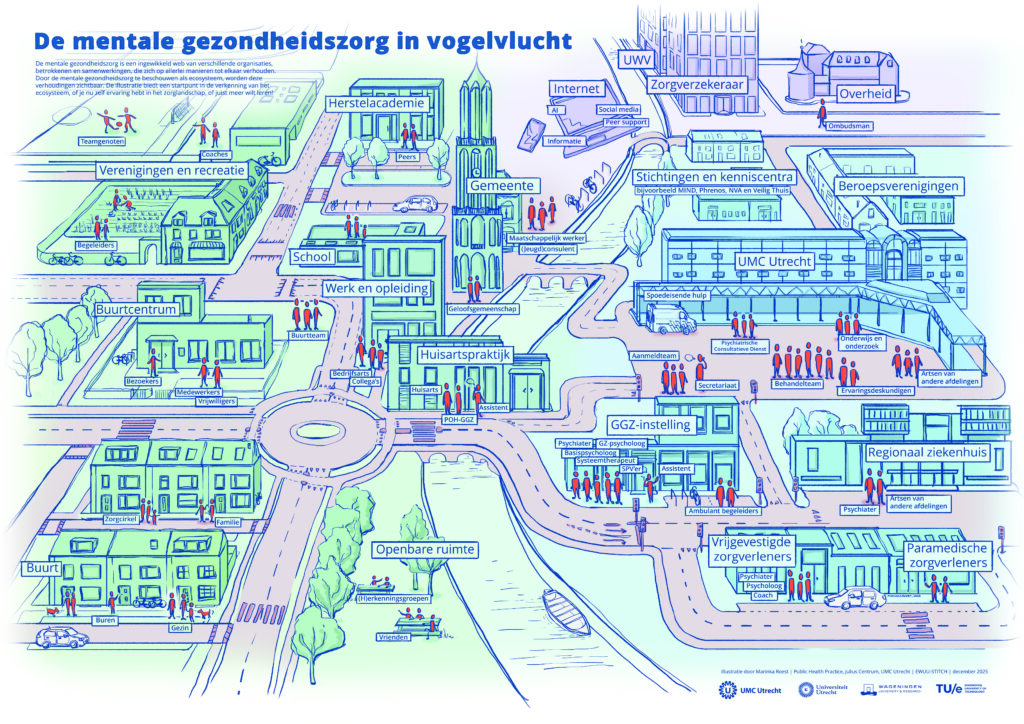
Graphic design: Marinka Roest
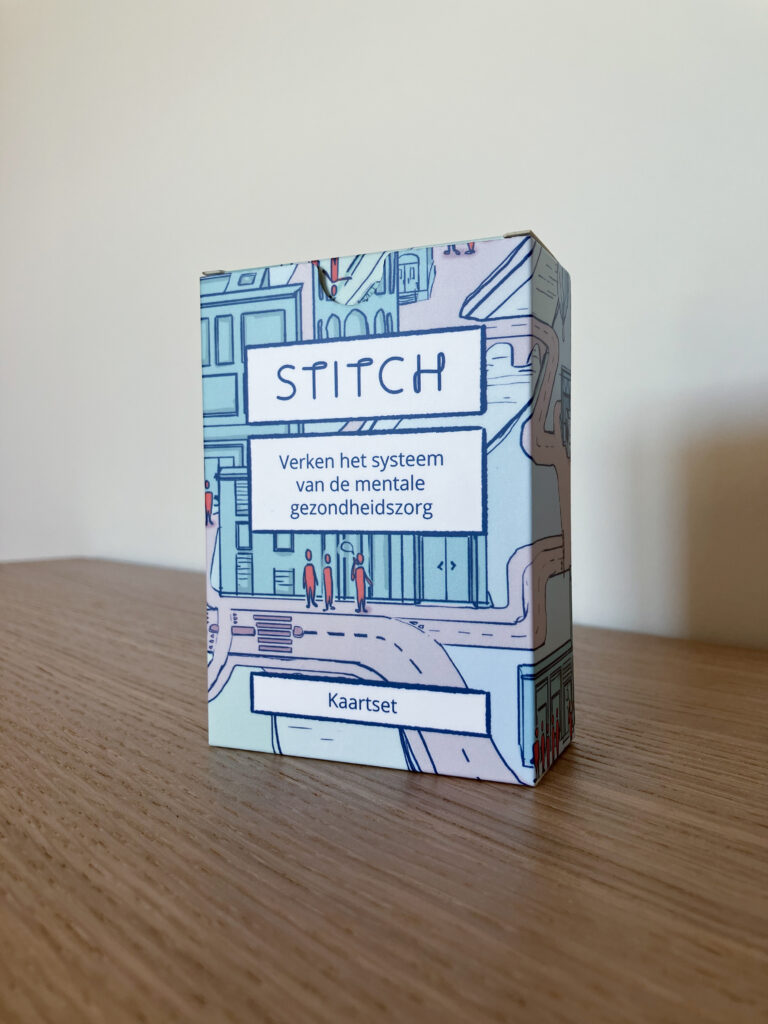
The STITCH card set
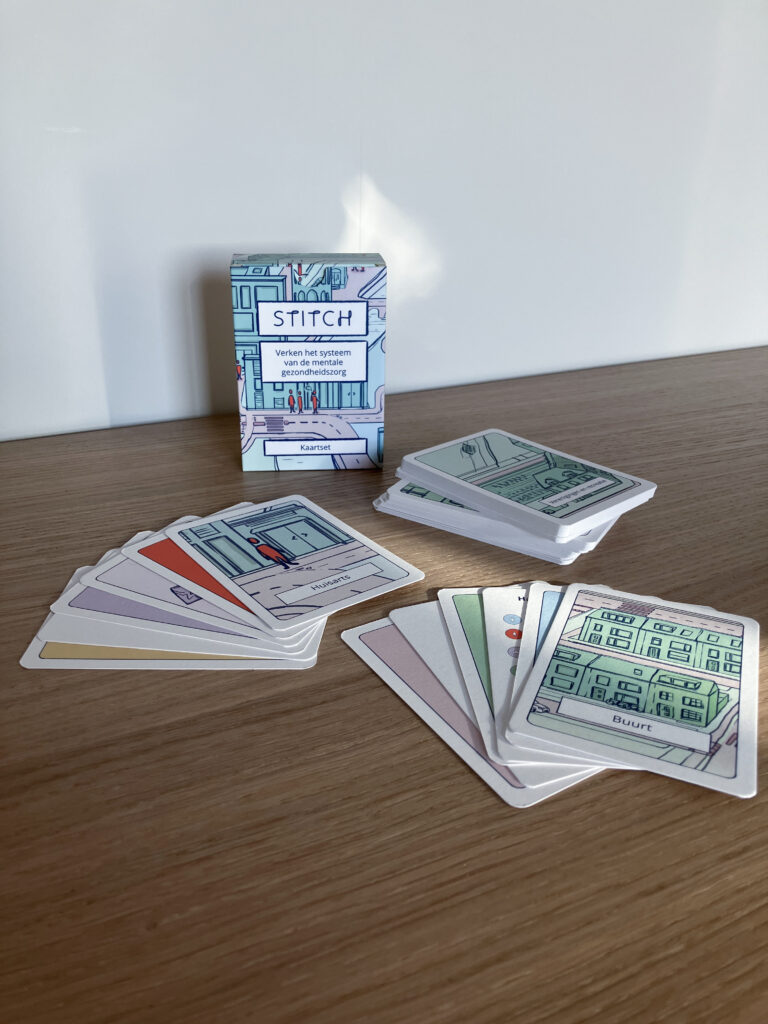
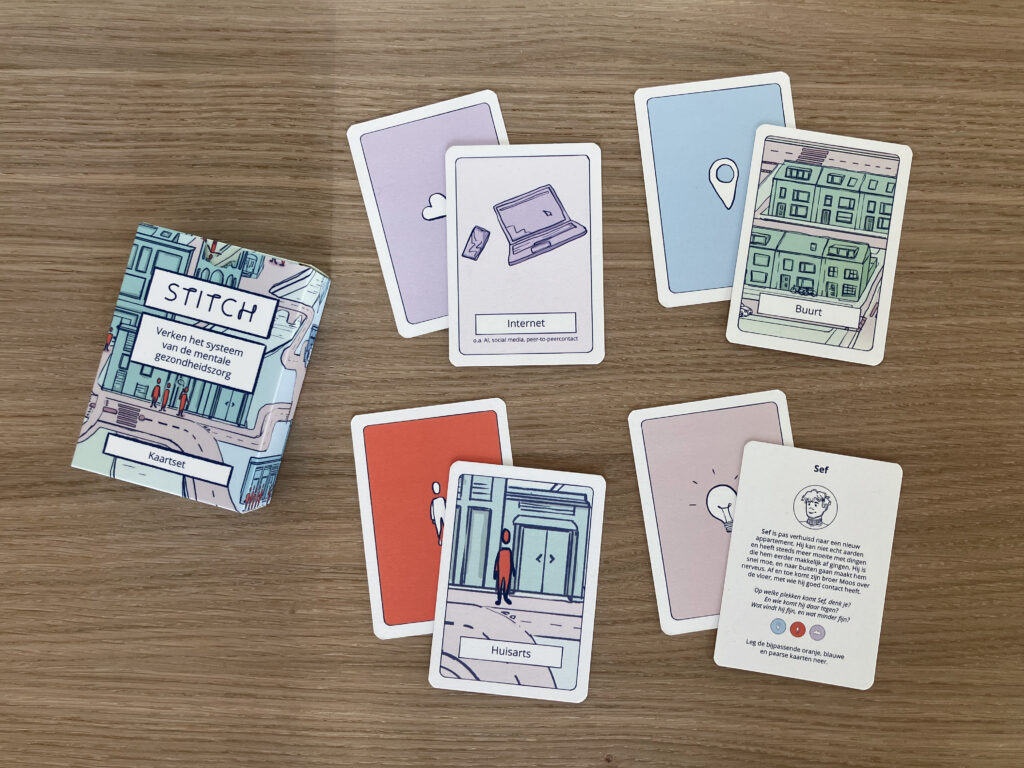
In addition to the overview, STITCH developed a card set that allows the mental healthcare system to be explored in an interactive way. The cards can be used to:
- discuss roles and responsibilities
- explore patient journeys
- visualise collaboration between stakeholders
The card set is suitable for use in care teams, education, co-creation sessions and policy contexts.
Graphic design: Marinka Roest
Interested in a card set?
There are three physical STITCH card sets available to be shared. To be considered, we ask you to complete a short content form.
To apply, please email us at info@ewuu.nl and include:
- your name
- organisation / context
- intended setting of use
- how you plan to use the card set
Selected applicants will be contacted to request a postal address.
Please use the following subject line: STITCH card set request
Learn more about STITCH
More information about the project, consortium and research line is available on the project page:
Making the system visible to enable change
STITCH shows that mental healthcare is not a collection of isolated elements, but a connected system. By making that system visible, space emerges for better collaboration, more targeted interventions and sustainable impact.