How can we develop digital health solutions that are not only innovative, but also meaningful in everyday life?
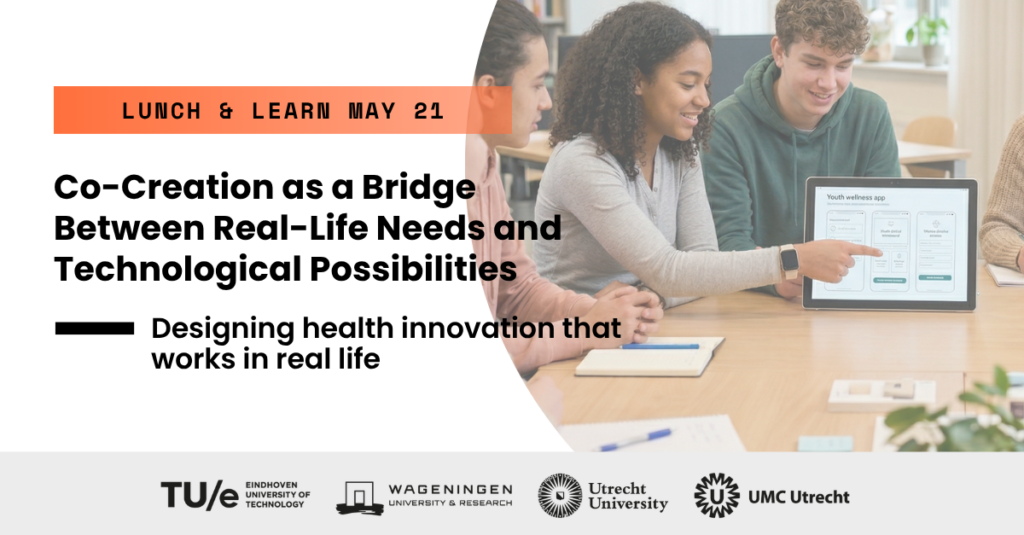
In this online Lunch & Learn, the Institute for Preventive Health explores how co-creation and participatory research help connect technological opportunities with people’s real needs, contexts, and lived experiences.
Drawing on insights from the LIFTS project, the session highlights how researchers, professionals, schools, and public-health partners work together with citizens to shape health technologies that are accessible, relevant, and engaging. LIFTS focuses on promoting a sustainable healthy lifestyle among low-literate teenagers in practical education and uses participatory research to develop solutions that fit their daily lives.
A distinctive element of the project is its use of four living labs around practical education schools, where students, parents, teachers, carers, designers, policymakers, and researchers work together.
The session brings together four PhD candidates working on different dimensions of the LIFTS project:

Daniëlla van Uden (Wageningen University & Research, Health and Society Chair Group) focuses on how students in practical education can best be involved in research and how newly developed technological innovations can be sustainably implemented in these school settings.

Madelief Engels (Wageningen University & Research, Marketing and Consumer Behaviour Group) investigates how students in practical education can be encouraged towards healthier and more sustainable eating behaviour, and how technology can help support and strengthen this behaviour.

Maria Inês Ribeiro (Eindhoven University of Technology, Information Systems) explores how personalised and AI-supported digital tools can encourage students in practical education to be more physically active. Together with students and schools, she designs solutions that connect with their needs and daily lives.

Simone Ooms (Utrecht University, Human-Centred Computing group) focuses her research on how the mental health of students in practical education can be promoted. She explores which behavioural developments can support mental health and how technology can contribute to a fitting and effective intervention.
The session starts with a short introduction to LIFTS and its co-creation approach, followed by discussion and an open Q&A.
Practical information
- Date: Thursday 21 May 2026
- Time: 12:15–13:00 (CET)
- Language: English
- Recording: This session will be recorded and shared online afterwards.
Register to join this Lunch & Learn and take part in the conversation on co-creation, participatory research, and meaningful digital health innovation.