At the EWUU – institute 4 Preventive Health (i4PH), we drive systemic transitions toward a fundamentally different approach to health and prevention. Lasting improvements in health and reductions in health inequalities require change across healthcare, public policy, living environments, technology, and society — so we work transdisciplinary, bringing together perspectives and sectors to accelerate transformative change toward healthier people, communities, and environments.
Quick access:
About the Call
Our vision: a healthier Netherlands for all. We align with Health Holland’s Knowledge and Innovation Agenda: +5 years of healthy lifespan for every Dutch citizen and –30% in health disparities by 2040. We aim to direct our research towards groups where we can achieve the most substantial improvement in health outcomes, especially people living in circumstances that make them vulnerable. We involve their experiences, priorities, and ideas when shaping research from the start. We focus on critical life stages while driving system-wide transitions in preventive health that are more inclusive, sustainable, and impactful.
Through this Seed Call we catalyse new collaborations and ideas that accelerate these transitions and strengthen future transdisciplinary funding consortia. We invite innovative, transdisciplinary proposals that contribute to one or more EWUU – i4PH Transition Pathways and align with our Research Themes.
Seed funding supports tangible outcomes — for example turning your project idea into a larger application (e.g. Horizon Europe, NWA), developing a white paper or literature review, organizing co-design workshops or building new collaborations with societal stakeholders, policymakers, healthcare organisations, or living-lab environments.
Research Focus
At EWUU – i4PH, we focus our research efforts through a combination of Research Lines (what we study) and Transition Pathways (how change towards preventive health can be achieved).
Transition pathways
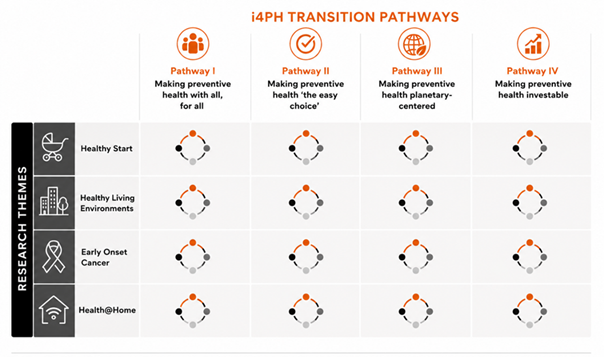
The EWUU – i4PH Transition Pathways are based on research of preventive health transitions in the Netherlands, conducted in collaboration with the Copernicus Institute of Sustainable Development (UU). The four pathways were derived from stakeholder interviews within and beyond the EWUU institutes and extensive literature review and resulted in four future scenarios.
Together, these pathways represent key leverage points for accelerating the transition towards healthier and more equitable societies. They help identify where scientific knowledge, innovation, policy, and societal action can create the greatest impact, while providing a shared framework for connecting and aligning diverse research and stakeholder initiatives.
Click to open for more information:
Preventive health with all, for all
Treats preventive health as a shared public good and a community responsibility rather than an individual one. Embeds “Health in All Policies” across housing, education, urban planning, and social policy; develops community-based services, and participatory governance. Tackles structural drivers — poverty, loneliness, discrimination, poor housing, unhealthy commercial practices — and scales local innovations such as caring neighbourhoods and community health platforms.
Preventive health as the easy choice
Makes healthy living the default by redesigning physical, social, fiscal, and digital environments. Moves beyond education and individual responsibility toward structural prevention: restricting unhealthy food marketing, reducing fast-food outlet density, investing in cycling and green infrastructure, and embedding health impact assessments in spatial planning. Healthy behaviour becomes the norm and enabled through coordinated action by governments, schools, employers, communities, and digital platforms.
Preventive health, planetary-centred
Integrates planetary health into prevention by recognising the interdependence of human wellbeing, ecological sustainability, and the health of other species. Aligns health, climate, environmental, agricultural, and spatial policies across governance levels: reducing environmental exposures, expanding green infrastructure, embedding planetary metrics in decision-making, and building integrated environmental–health monitoring. Governments, universities, NGOs, businesses, and communities collaborate on sustainable lifestyles and preventive systems that minimise their own ecological footprint.
Preventive health as investment
Frames prevention as a long-term societal investment in health, wellbeing, equity, productivity, and welfare — not merely a way to cut healthcare costs. The pathway promotes cross-sector financing, joint investment funds, broader return-on-investment frameworks, and structural embedding of prevention in governance and financial systems.
Seed Call Research Themes
Optimal physical, social, and mental functioning, and self-efficacy, are foundational for healthy and productive lives across every life stage — from adolescence to working age to old age. EWUU – i4PH studies how lifestyle and environmental factors influence independent functioning, how biological and social systems shape resilience, and how lifestyle, healthcare, and environmental, societal, or technological innovation can enhance self-efficacy. We seek system-level change that combines solutions across domains for sustained wellbeing, independent functioning, and self-efficacy throughout life.
Click to open for more information:
Healthy start
By focusing on children and families, particularly during the transition from primary to secondary school and onwards until children leave home, we aim to address societal challenges such as peer pressure, limited access to healthy lifestyle options, and mental health issues. Particular attention is given to children and young people with somatic and non-somatic limitations, recognising the importance of resilience, adaptive capacity, and inclusive support systems in promoting healthy development during critical life stages. We welcome research proposals that contribute to healthy development, resilience, inclusive participation, and successful life-course transitions through preventive, technological, social, or environmental approaches.
Healthy living environments
Our living environment is a major structural driver of our health and wellbeing, significantly impacting health. Our living environment provides us with a large arsenal of health-promoting interventions in four interacting dimensions of the living environment: built environment (e.g., roads, bike lanes, parks), chemical/biological environment (e.g., pollutants), social environment (e.g., social networks, participation, safety) and food environment (e.g. healthy food outlets). We welcome research proposals that develop, evaluate, or implement interventions and policies aimed at creating healthier, more inclusive, and sustainable living environments for diverse populations.
The future of cancer
Cancer affects people of all ages and has major impacts on individuals, families, and society throughout the life course. This theme focuses on supporting people under the age of 49 during and after cancer treatment by improving quality of life, resilience, participation in society, and long-term physical, mental, and social wellbeing. We explore how lifestyle, living environment, technology, and supportive care can help patients during treatment, improve outcomes, enable timely detection of complications or deterioration, and strengthen recovery and functioning for individuals living with or beyond cancer. We welcome research proposals focused on supportive care, remote patient monitoring, recovery, survivorship, prevention of recurrence, and improving long-term wellbeing and participation for people affected by cancer.
Health @ Home
With the goal of promoting digital self-management and self-organization, this research theme focuses on frail elderly individuals and those at risk of institutionalization. By harnessing technological innovations and implementing living lab environments, we seek to optimize functioning, enhance participation in society, and improve overall well-being of this group. We welcome research proposals that advance digital health, remote monitoring, self-management, healthy ageing in place, and innovative home-based support systems that enable independent living and societal participation.
This Call for Projects aims to stimulate ideas for research projects from within the Alliance TU/e, WUR, UU, and UMCU on Preventive Health that will contribute to the further development and implementation of the i4PH research and transition agenda.
Applicants are therefore encouraged to submit proposals that fit within at least one research line and one or more transition pathways, fostering connections between scientific excellence and societal impact (see next picture).
Timelines
| Submission deadline | 16 October 2026, 23:59 CET |
| Evaluation period | October–November 2026 |
| Funding decisions communicated | December 2026 |
| Project start date | From 1 January 2027 |
Full call text and relevant documents
For the full call text, and other relevant documentation, please see below: